
Paradigmi (Paradigms) is a multidisciplinary public festival hosted at the Palazzo Ducale in Genoa, Italy, now in its fourth edition, which brings together scholars, artists, and thinkers to examine the concepts that shape how we understand the world. When I was invited to speak there about motherhood – as a scholar working at the intersection of gender studies, feminist theory, and translation – I found myself pausing at the festival’s title. What kind of paradigm is motherhood? The question appears straightforward until one presses on it, and then it opens onto something stranger and more generative than expected.
What Grammar Has to Do with It
The word paradigm carries a meaning we rarely reach for: the grammatical paradigm, the full table of conjugations of a verb – I love, you love, she loves… – that students learn in school. A paradigm is not the infinitive form plus a list of exceptions. It is the totality of forms. Variation is not deviation from the norm; it is the grammar itself.
This is the sense I want to apply to motherhood. Its naturalisation, the assumption that it is a biological given rather than a social and political construction, remains one of the most durable mandates of patriarchal culture. Since Adrienne Rich’s pioneering Of Woman Born (1976), feminist scholarship has spent decades making this structure visible, showing how the maternal operates as an organising principle for gender norms, labour distribution, and political belonging. But motherhood is not simply a framework that constrains thoughts and practices. It is a root that inflects – differently, constitutively, intersectionally – according to who lives it, in what body, in what economy, in what kinship arrangement. The task of feminist theory is not to identify which inflection is the authentic one, but to read the full paradigm: to recognise all the forms as equally constitutive of the structure. And here is the tension that makes this image so useful: the paradigm table is taught precisely to normalise. You learn the conjugation to internalise the rules, to reproduce the structure without thinking. Motherhood works the same way – simultaneously a structure of possibilities and a mechanism of regulation.
The Social Grammar of Inequality
To think of motherhood as a conjugating paradigm is not to suggest that all conjugations are equally available or equally costly. Here the metaphor acquires critical force. Research on the “maternal penalty” demonstrates that the social grammar of motherhood is profoundly unequal. Wage gaps, career interruptions, and professional devaluation fall most heavily on those in precarious employment, lower-income brackets, or contexts lacking robust public childcare. These penalties are further stratified by race, class, and educational attainment.
In grammatical terms: the social grammar designates certain conjugations of motherhood as first-person-singular present, the norm institutions are organised around. Others get pushed into the past perfect subjunctive. That is the tense we rarely need, the one that marks an action as hypothetical and remote: had she been able to, had it been otherwise. These are the forms of motherhood that fall outside what society treats as normal or desirable. Those with greater resources can navigate across multiple tenses – postponing, choosing, combining roles – whilst others find themselves locked into a continuous present with no available future tense. The maternal penalty is, in this sense, the price of irregular conjugation.
A Feminism for Mothers
It is here that Rich’s foundational distinction becomes newly legible. Rich distinguished between motherhood as institution, the norms, expectations, and power relations imposed upon mothers; and mothering as lived experience: the varied, embodied, potentially empowering practice of caring for a child. The institution enforces the norm; the experience exceeds it. If motherhood-as-institution is the conjugation table as presented in the grammar book – fixed and apparently universal – then mothering-as-experience is the full range of inflections that mothers actually produce, including those the institution does not recognise or actively marginalises.
Andrea O’Reilly’s matricentric feminism takes this further. Her argument begins with an internal critique of a feminist tradition that has often treated motherhood as an obstacle to equality, to be neutralised or redistributed so that women can participate fully in public life. These demands are legitimate. But to O’Reilly they are insufficient, as they leave intact the deeper devaluation of mothering as experience, practice, and form of knowledge. They accept the liberal model of the autonomous, productive subject and ask only that mothers be accommodated within it.
Matricentric feminism proposes instead to centre the mother as a political subject in her own right, not despite, but through the perspective generated by caregiving. Drawing on Sara Ruddick’s concept of maternal thinking, O’Reilly contends that the daily practice of caring for a child generates a distinctive way of knowing and acting politically. Dependency is not weakness; care is not submission; relationality is not the negation of subjectivity. Matricentric feminism thus invites us to view mothers not only as speakers who decline a verb within an existing grammar, but as agents capable of rewriting the grammar itself.
The Paradigm as Political Tool
Feminist work on motherhood – theoretical, empirical, political – operates on both sides of the paradigm’s tension at once. It exposes how a particular conjugation has been universalised as the norm. And it makes visible the other conjugations: the forms that exist, have always existed, but have been marked as irregular or marginal. Motherhood was never one thing. It has always been a table of conjugations, waiting to be read in full. The question is not whether motherhood is a paradigm. It is who gets to write the grammar.
References
Rich, A. (1976). Of Woman Born: Motherhood as Experience and Institution. W. W. Norton.
Cover image
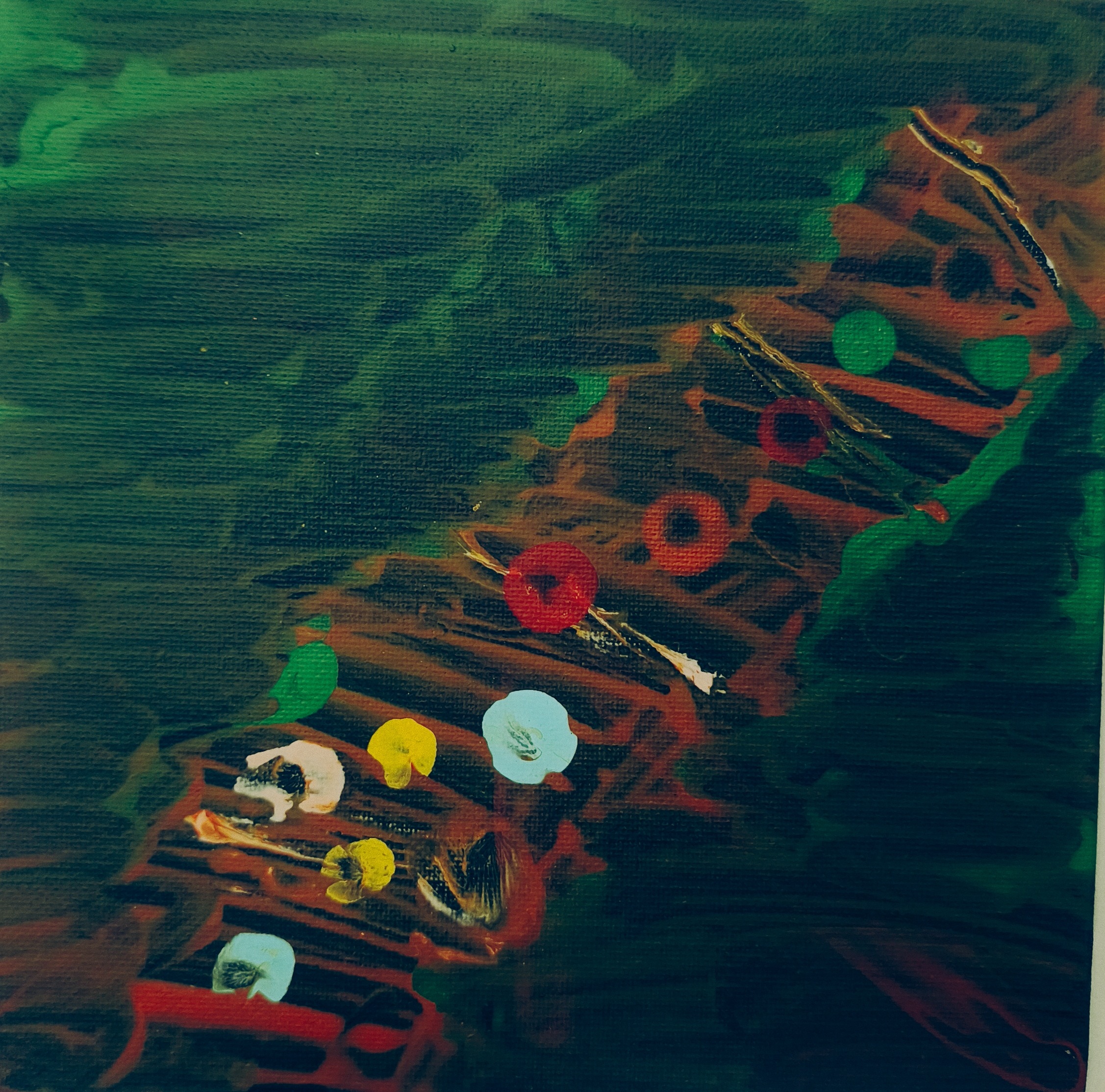
A painting by Aida Euridice Ceruti entitled ‘To the Mother: A Paradigm’ (2026).
Veronica Frigeni holds a PhD in Italian Studies from the University of Kent (2018). She is currently a postdoctoral visiting researcher at the Center for Transdisciplinary Gender Studies (ZtG) at Humboldt-Universität zu Berlin, where she teaches a graduate course on motherhood and contemporary Italian literature. She recently translated and edited the Italian edition of Andrea O’Reilly’s Maternità femministe (Prospero, 2025) and the English translation of Orsola Severini’s novel The Choice (Demeter Press, 2025). She serves on the editorial boards of the Journal of the Motherhood Initiative and Critical Gender Studies Journal.