
Like a kaleidoscope, popular culture reflects a fast-changing colourful world, combining many pieces, representations, meanings and emotions depending on both its structure and how you view it. With such a multi-voiced and dynamic atmosphere, pop culture plays a prominent role in many girls’ lives all around the world, but it has a particular significance for migrant girls in Germany. Particularly TikTok, K-Pop and Turkish TV series all play a special role in their everyday lives as affective fields of interaction and community building. As Fatima, a 17-year-old from Syria living in Berlin, reflects, “popular culture not only makes you have fun but also brings you together with your friends and put sparkles in you, makes you feel familiar in this foreign land.”
In my postdoctoral project, “Voices on the Move: Cultural Practices and Popular Culture in Everyday Lives of Migrant Girls”, I aim to understand this “sparkle” and “familiarity”. My research was conducted at the Center for Transdisciplinary Gender Studies at Humboldt-Universität zu Berlin from March to August 2025, and supported by the TÜBİTAK 2219 International Postdoctoral Research Fellowship Programme for Turkish Citizens. The project askes how popular culture engages with their interests, emotions and needs of migrant girls and looks at how it plays a role as they settle into a new life in Germany. Based on qualitative research and feminist methodology, the research combines ethnographic fieldwork with arts-based participatory methods to capture the girls’ lived experiences.
Why popular culture?
Alongside my academic work, I have long been involved in feminist community and youth work. For more than ten years, I’ve also been a part of the Hacettepe University Faculty of Communication Digital Storytelling Unit, which includes (co)facilitating workshops on topics such as gender and migration. Moreover, I have collaborated with several NGOs in Germany and Turkey since 2017, running arts-based participatory workshops, mainly for and with young migrant women. Across these experiences, popular culture repeatedly appeared to be a very powerful key for establishing a dialogue with migrant girls to talk about their migration journeys, struggles and strengths. These encounters, together with my background in Cultural and Girlhood Studies, provided the conceptual foundation for this research.
Multiple sites, diverse perspectives
Drawing on feminist methodology, the ethnographic fieldwork combined participant observation with semi-structured in-depth interviews. The interviews were with 25 migrant girls aged between 11 and 18, from countries such as Syria, Afghanistan, Iraq and Turkey. All had migrated in the last decade due to war, insecurity and/or political turmoil. Most of them identified as Muslims. At the time of the interviews, ten participants lived with their families in shelters while the others lived in flats across Berlin and Potsdam.
I ran workshops in two girls’ centres in Lichtenberg and Charlottenburg, as well as in a shelter in Lichtenberg and in my home district of Neukölln. The arts-based participatory workshops were on the subjects of collage, photovoice and digital storytelling, together with meetings on cooking, handicrafts and dance. The digital stories that were approved by the participants/parents were later shared on the Hacettepe University Faculty of Communication Digital Storytelling Unit’s website.
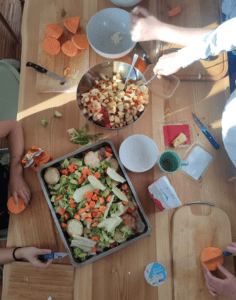
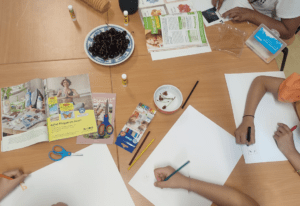
Impressions from the workshops*
TikTok, K-Pop and Turkish TV Series
The fieldwork revealed that popular culture operates as an effective source through which migrant girls construct their identities and navigate belonging. Social media platforms, particularly Instagram, Facebook and TikTok, are central to migrant girls‘ everyday lives, and they all prefer meeting with their friends online. This preference is shaped by security issues, experiences of discrimination, bullying and exclusion – in other words, being “invisible for example at school but too visible on the streets” as Riham expressed alongside household responsibilities and parental restrictions.
Due to its immense popularity, TikTok becomes an important part of the migrant girls’ lives by pulling them into its stream of videos. In addition, as Aisha explains in her digital story, TikTok “has everything, like its own little world”. Most girls keep their accounts private, creating their own intimate environment with friends and a space of belonging rather than public visibility. In particular, their collective videos of dance challenges become their shared rituals of fun and connection.
Nineteen girls had lived in Turkey before migrating to Germany, and many can speak Turkish. Thus, Turkish TV series such as Kiralık Aşk, Diriliş Ertuğrul, and Erkenci Kuş offer a familiar cultural bridge, mediating between their homeland and Germany. The girls find the recognizable emotions, familiar cultural and traditional codes, and comfort that are missing in their sociocultural life in Germany.
Korean popular culture, especially K-pop, is another central theme. The girls had a clear love of K-Pop dances, forming dance groups and performing collectively in places like schoolyards, parks, and the shelters they live in. For them, this form of dancing has a direct connection with developing a sense of being part of young fan community and embracing a feeling of belonging.
Paths to belonging and community building
The migrant girls’ feelings of exclusion and discrimination often coexisted with moments of resistance to being part of and integrating into the everyday life during the resettlement process. Such everyday experiences result in non-belonging; in other words, developing a resistance to belonging to the new country and societal dynamics. Furthermore, as their “home” countries remain associated with war and fear rather than diverse experiences and memories, and as the girls left them at a very young age, many do not feel strong bonds with their countries of origin. The only different voices within this context came from the migrant girls with Kurdish backgrounds. Since they have grown up in families who put a strong emphasis on their cultural and ethnic roots and bonds, they have developed a keen sense of resistance to the “integration” policies in the new country as well as a disinterest in the global popular culture, as Leyla mentions in her digital story.
Consequently, most of the migrant girls feel an “in-betweenness” and thus find and construct alternative spaces of belonging. In these spaces, they fulfil the need for being part of a larger collective where they can be seen and valued. Fields of pop culture, such as TikTok, Turkish TV series and K-pop, become their “imagined homes”, “where no one asks where they are from”. Therefore, while interacting with popular culture provides pleasure and enjoyment, it also acts as an autonomous space where migrant girls can build affective communities rooted in shared emotions, bonds and mutual recognition rather than citizenship or territory.
* The photographs were taken by the author.
** I would like to thank Amy Visram, Julia Zimmermann and Kathleen Heft for their suggestions. In addition, I’m grateful to Lioba Spörlein for her remarkable support throughout the fieldwork and cherished friendship.
Burcu Şenel Alpuğan holds a PhD in Communication Sciences, from Hacettepe University- Ankara, Turkey, and works as a lecturer in the same department. Her academic interests include gender/girlhood studies, ethnography, everyday life studies, popular culture, new media studies and digital storytelling. As a workshop facilitator and feminist youth worker, she has extensive experience conducting arts-based participatory workshops, in particular with young migrant women in many projects/workshops organized by several NGOs in both Germany and Turkey. (busenel@hacettepe.edu.tr)