
What provisions does it take to live in temporal and spatial in-betweenness, never quite knowing when, or if, return is possible – or even where to? How do we make homes from what can be carried on a migratory road: objects ready to move at any moment, yet still holding the weight of memory and care?
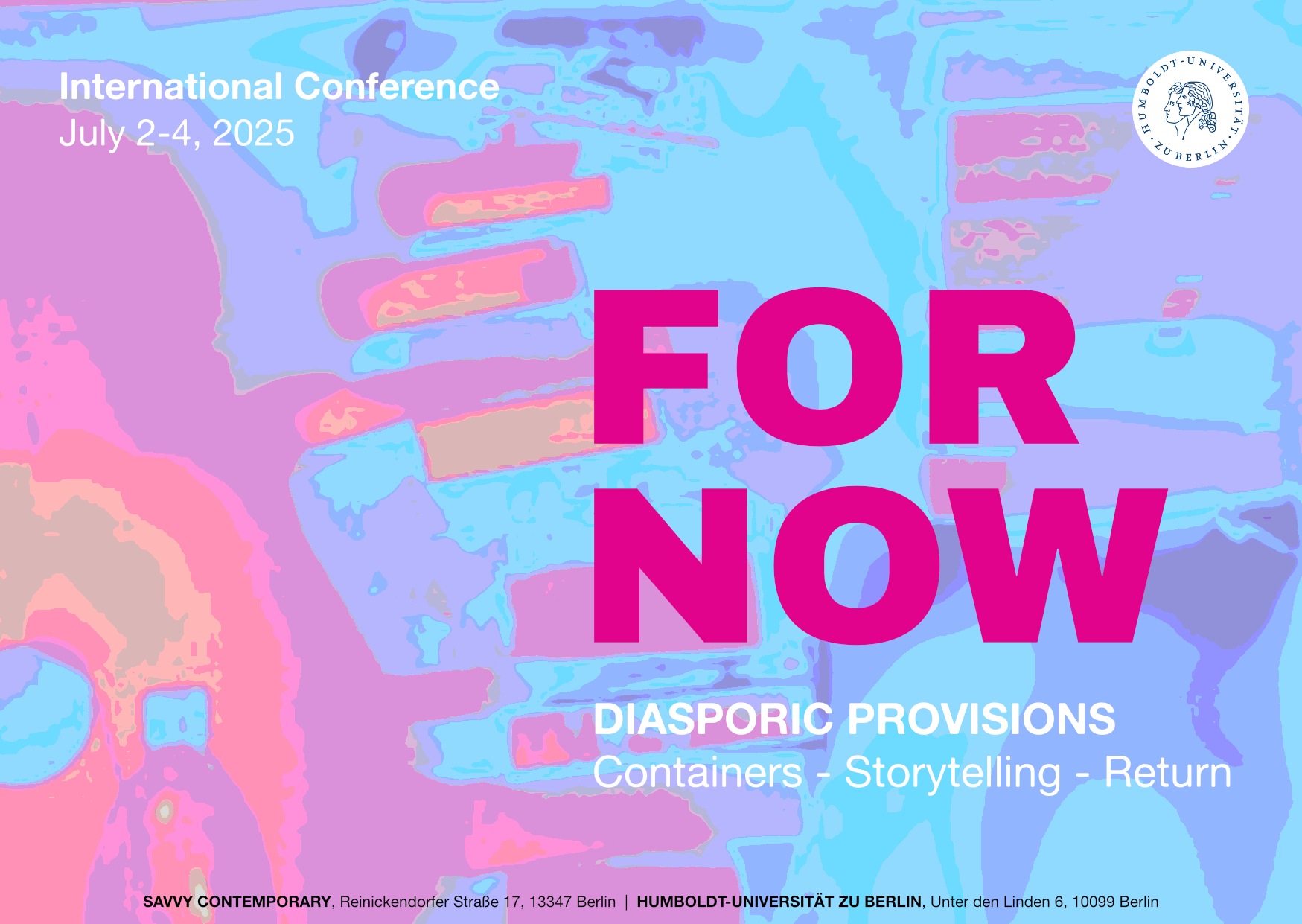
For Now: Diasporic Provisions. Containers – Storytelling – Return (2–4 July 2025) approached these questions as both declaration and experimental space to reflect and dream together. Held between SAVVY Contemporary and Humboldt-Universität zu Berlin (HU Berlin), the conference marked a deliberate claiming of space in the city. As the conference of the ERC Consolidator Grant project Tales of the Diasporic Ordinary, it unfolded along three intertwined strands: “Containers” asked how memory and affect are carried; “Storytelling” traced the patterns and gaps through which queer and diasporic ordinaries emerge; and “Return” followed homecomings and provisional routes of going back through fragmented language, alternative kinships, and “resilient wariness.”
Containers
The first day at SAVVY Contemporary stayed close to diasporic objects and haunted atmospheres: ice-cream tubs reutilized as storage, cookie tins as makeshift sewing kits, the mental fog of scrolling through war imagery, the chemical afterlife of toxins in the soil. In the opening session, Apocalyptic Intoxication, Maithu Bùi and Thao Ho described “apocalyptic moments” of memory mining and technological mediation: learning family histories of forced migration through Western war cinema, and seeing those histories repurposed as backdrop for US military mythology in films like Apocalypse Now, even as substances like Agent Orange remain in the ground, binding Vietnam to other sites of slow violence. Their research into practices of demining – machines such as metal detectors, and cyborgian animal bodies like the so-called “bomb rats” – traced how these technologies are unevenly distributed along lines of power.
From there, the notion of containers moved to names and memetic codes. In How to be (Un)known: Abstraction and Encryption in the Black British Diaspora, Fenja Akinde-Hummel’s “Elizabeth names” became vessels of legibility, offering respectable decoy selves to schools, border regimes, and employers, while other more intimate names, as well as jokes and affiliations circulate in encrypted meme cultures. “Create a decoy self” was one of the strategies that Akinde-Hummel and Otis Mensah articulated in response to the question, “How do you keep the self intact?” Reading hyperspecific memes and starter packs as dispensaries of Blackness, they showed how these images become fully readable only to those whose lives have been inscribed by the diasporan code.
In The Archive’s Hold, Lan P. Duong returned to containers at the scale of the cinematic archive. Drawing on Glissant’s “poetics of relation” (1997), she treated Vietnamese cinema, censored reels, and family home movies as vessels that hold grief and resistance across generations. Grieving, as a way of rearranging traces and linking times and places so that the archive becomes a container for past, present, and “not-yet” futures.
Storytelling
The second day at HU Berlin turned to the limits and possibilities of narrative form. The session From the Dream Archive offered a different mode of storytelling and treated the dream world no less important than the waking world. Todd & Zoya invited participants to nap together, meditate and reflect, while sharing fragments of their audio documentation of nightly dreams. Recorded and retold, these dreams became a way of thinking together about fear, longing, and possibility, searching for patterns of the subconscious mind and testing the bounds of what counts as an archive.
Lee Langvad’s Everyday Translation: Queer Diasporic Writing After Return extended these questions into the terrain of transnational adoption. Working in hybrid forms, Langvad used critical fabulation to write into the gaps of an adoptee’s return narrative, asking not just how one reaches the reunion, but what follows after. Langvad’s text repeatedly omits passages s/he cannot culturally and linguistically access – “My father said… / My interpreter says…” – turning ellipses and silence into a language of generational trauma. Refusing the familiar script of the white nuclear adoptive family, Langvad focuses instead on adoption as involuntary migration: a forced break where ties are cut so a new identity can be rapidly assumed. Shifting mechanisms of translation – interpreter, mobile app, strangers, family members – foreground how unstable “understanding” can be.
Return
The last day focused on a theme present throughout: whether return is possible, and on what terms. This concern was taken up in Anja Sunhyun Michaelsen’s Substitute Histories, where she showed how official archives of transnational Korean adoption foreground paperwork while the lives of birth parents, orphanages, and informal care networks remain fragmentary or erased. In response, adoptees and their communities assemble “substitute histories” from rumours, partial memories, online search groups, and speculative connections. These are not second-best to “real” facts, Michaelsen argued, but refusals of the neat humanitarian story that agencies and states prefer to tell, resonating with Langvad’s emphasis on the ongoing labour of living with gaps and institutional silence.
Rhaisa Williams’s hybrid session For Now, Always – Temporal Feelings of a Dashed Ordinary approached return through the textures of Black diasporic everyday life. Working with family stories – her grandmother’s fear of cotton and father strategies of trying to be remembered – she developed the notion of “resilient wariness”: a way of carrying time and weathering crisis whilst always feeling that something is just out of reach.
Across the conference, diaspora emerged through grief and fatigue but also collective rest and reflection, which brought forth the insistence and realization that “the way we do life is a method.” A method shaped by fragmentation but also intuition and speculative knowing, showing that there might not be a neat ending to the story. If there was a promise in For Now, it was precisely this: that the provisional, the makeshift, the not-quite-finished are not failures of arrival, but the very conditions under which diasporic worlds evolve… for now.
Literature:
Glissant, Édouard. 1997. Poetics of Relation. Translated by Betsy Wing. Ann Arbor: University of Michigan Press.
Aminata Estelle Diouf is an artist, curator, and researcher in media and cultural anthropology. Her work explores visual and performance art, film, at the intersection of decolonial practices in the Black diaspora. She is currently pursuing a PhD at the University of Cologne in the DFG-funded research group Connecting–Excluding. As a co-author she wrote the theatre play “The Waterbearer” together with the collective Black German Arts and Culture in Düsseldorf in 2024 and co-curated the 2023 exhibition My Life Began Several Centuries Ago – An Ecosystem of Circulating Images for the Akademie der Künste der Welt, Cologne.